Effective pest control cost management across a property portfolio is defined as the systematic process of budgeting, contracting, and monitoring pest services to minimize expenses while maintaining compliance and tenant safety. Property managers who treat pest control as a line item rather than a risk management function consistently overspend. One-time visits for a 1,500 sq. ft. property cost between $108 and $261, while ongoing monthly plans average $40 to $70 per treatment. Multiply those figures across dozens of units and the financial exposure becomes significant. The strategies in this guide will help you manage pest control costs across your portfolio with precision, not guesswork.
How does portfolio composition affect pest control costs?
Portfolio composition is the single biggest cost driver in pest control budgeting, and most managers underestimate it. A mixed-use building adjacent to a restaurant row faces fundamentally different pest pressure than a suburban garden-style apartment complex. Property mix, geography, and building features all influence pricing, and adjacency to dumpsters or food service operations increases both pest risk and service frequency requirements.
The practical solution is to segment your properties by risk archetypes before signing any portfolio-wide agreement. Risk archetypes group properties by shared characteristics such as building age, unit density, proximity to food sources, and local pest pressure. A garden-style complex in a low-density area might need quarterly visits, while a high-rise in central London may require monthly inspections plus targeted treatments for bedbugs and rodents.
Here is how to build a simple risk segmentation framework:
- High-risk properties: Urban locations, mixed-use buildings, older construction with structural gaps, proximity to restaurants or waste facilities
- Medium-risk properties: Suburban multifamily, mid-age buildings, limited food service exposure
- Low-risk properties: Newer construction, single-use residential, low-density areas with strong maintenance records
Segmenting this way prevents you from paying high-risk rates across your entire portfolio. It also gives you the data to push back on blanket pricing from providers. For context on how asset type and location shape service requirements, the differences between property categories are substantial.
Pro Tip: Request a property-specific Integrated Pest Management plan for each risk tier, even when negotiating a portfolio-wide contract. Blanket agreements without property-level plans lead to over-servicing low-risk units and under-servicing high-risk ones.
What budgeting strategies help control pest control expenses effectively?
Accurate pest control financial planning starts with understanding the difference between fixed and variable costs. Fixed costs include scheduled inspection visits and routine monitoring. Variable costs cover emergency call-outs, specialized treatments for bedbugs or rodents, and callbacks after failed treatments. Most managers budget only for the fixed component and get blindsided by variable spend.

The most reliable method for pest control cost analysis is calculating the true annual per-unit cost. This means adding up all scheduled visits, any special treatments, emergency fees, and callback charges across a full 12-month period, then dividing by the number of units serviced. Annual per-unit cost should include initial visits, which are priced higher, and any follow-up treatments that fall outside the base contract.
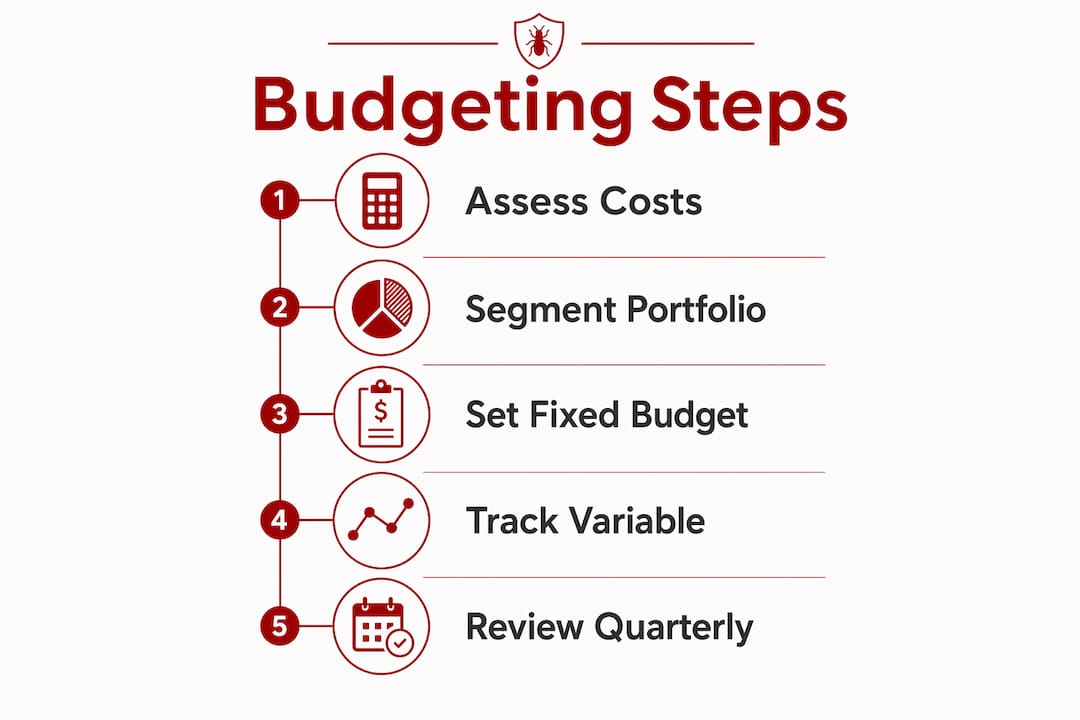
Here is a step-by-step approach to building a defensible pest control budget:
- Audit last year’s invoices. Pull every pest control invoice from the past 12 months and categorize spend by property, service type, and whether the charge was scheduled or reactive.
- Calculate per-unit annual cost. Divide total annual spend per property by the number of units. This is your baseline benchmark.
- Identify cost outliers. Properties spending more than 20% above the portfolio average warrant a closer look at service frequency, pest pressure, or billing accuracy.
- Separate contract scope from extras. Reconciling billed services to actual contract scope reveals duplicate charges, unauthorized upgrades, and billing errors that inflate costs.
- Set a contingency reserve. Allocate 10 to 15% of your annual pest control budget for emergency treatments and reactive events.
The table below shows typical cost ranges by service plan type to help you benchmark your current spend:
| Plan type | Typical cost per visit | Annual cost estimate |
|---|---|---|
| Monthly visits | $40 to $70 | $480 to $840 |
| Quarterly visits | $100 to $300 | $400 to $1,200 |
| Annual plan | N/A | $300 to $900 |
| One-time visit | $108 to $261 | N/A |
Pro Tip: Centralize all pest control billing through one accounts payable workflow. When invoices arrive from multiple providers across multiple properties, discrepancies hide easily. A single reconciliation process catches overcharges faster.
How to select and negotiate pest control contracts for your portfolio?
Contract selection is where most of the real savings in optimizing pest control costs are captured. The mistake most managers make is comparing per-visit prices without examining what each visit actually includes. Providers price to inclusion matrices and service level agreements, meaning a lower per-visit rate often excludes callbacks, emergency call-outs, or treatments for secondary pest types.
When evaluating providers for a portfolio agreement, focus on these factors:
- Volume discounts: Confirm that discounts scale with unit count and are applied consistently across all properties, not just the flagship sites.
- Bundled services: Ask whether rodent control, bedbug monitoring, and ant treatments are included or priced separately.
- Callback guarantees: A provider who charges for every callback creates a perverse incentive to underperform on the first visit.
- Emergency call-out terms: Clarify response time commitments and whether emergency visits are billed at standard or premium rates.
- Dedicated account management: Portfolio accounts benefit from a single point of contact who understands your property mix and can flag trends across sites.
- Reporting tools: Digital reporting platforms that log inspection results, treatment records, and pest activity trends are worth paying for. Inspection documentation reduces financial losses by proving due diligence and preventing costly disputes.
For managers reviewing commercial cleaning contract checklists, many of the same principles apply to pest control agreements. Scope clarity, escalation procedures, and performance metrics all belong in a well-structured pest control contract.
Pro Tip: Never accept a contract that defines “included pests” vaguely. Require a written inclusions matrix listing every pest species covered, the treatment methods authorized, and the maximum number of visits per year. Ambiguity always costs you money.
What IPM methods reduce costs while improving safety?
Integrated Pest Management, or IPM, is defined by the EPA as a science-based approach that combines prevention, monitoring, and targeted treatment to manage pests with minimal risk to people and the environment. Reactive pest control costs 3 to 5 times more than IPM over time, because emergency treatments, legal liability from infestations, and tenant turnover all compound the financial damage.
The comparison below shows the practical difference between reactive and IPM-based approaches:
| Factor | Reactive pest control | IPM-based pest control |
|---|---|---|
| Cost structure | High variable, unpredictable | Lower fixed, predictable |
| Pesticide use | High, broad-spectrum | Targeted, minimal |
| Emergency events | Frequent | Rare |
| Tenant impact | Disruptive, reactive | Proactive, low disruption |
| Compliance risk | Higher | Lower |
IPM combines cultural, mechanical, biological, and chemical tactics to prevent pest problems rather than simply responding to them. Cultural tactics include waste management protocols and tenant education. Mechanical tactics cover door sweeps, gap sealing, and screen maintenance. Biological controls use natural predators where appropriate. Chemical treatments are reserved for confirmed infestations and applied with precision.
“Consistent preventive programs yield better tenant satisfaction and reduce costs compared to reactive extermination cycles.” — Commercial Exterminator
The EPA endorsement of IPM carries weight in regulatory contexts too. Properties with documented IPM programs are better positioned during inspections and face lower liability exposure when pest-related complaints arise. For a closer look at how Quickpestcontrol applies IPM principles to professional pest control programs, the approach is built around prevention first.
How do you monitor and adjust your pest control program over time?
Monitoring is what separates a pest control program that saves money from one that just spends it. Emergency pest events cause budget instability, legal liability, and tenant turnover, and structured preventive programs with consistent monitoring are the most reliable way to prevent them.
Practical monitoring at the portfolio level involves several habits:
- Centralize pest activity data. Use a digital platform or shared spreadsheet to log inspection results, treatment dates, pest species identified, and callback frequency by property.
- Review trends quarterly. A property with three rodent callbacks in one quarter signals a structural issue, not just a pest issue. Catch it early and the fix is cheaper.
- Adjust service frequency based on data. If a low-risk property has had zero pest activity for 18 months, quarterly visits may be excessive. Reallocate that budget to higher-risk sites.
- Schedule proactive tenant communication. Notify tenants before scheduled inspections and provide simple prevention tips. Tenants who report early signs of activity reduce the cost of late-stage infestations.
- Train maintenance staff on prevention basics. Staff who recognize early signs of rodent activity, bedbug indicators, or ant trails can flag issues before they escalate. This is free monitoring that most portfolios ignore.
Pro Tip: Set a quarterly pest control review meeting with your provider. Review pest activity reports, callback rates, and any properties trending above budget. Providers who resist this level of transparency are a red flag.
For operational ideas on reducing emergency pest incidents, small maintenance changes often deliver outsized results in pest prevention.
Key takeaways
Effective portfolio pest control cost management requires risk-based segmentation, true annual per-unit cost tracking, and IPM adoption to replace reactive spending with predictable, preventive investment.
| Point | Details |
|---|---|
| Segment by risk archetype | Group properties by pest pressure and building type to avoid blanket contract overcharges. |
| Calculate true annual cost | Include all visits, callbacks, and emergency fees per unit to build an accurate budget baseline. |
| Scrutinize contract inclusions | Require a written inclusions matrix to prevent hidden fees and scope ambiguity. |
| Adopt IPM over reactive control | IPM costs 3 to 5 times less than reactive treatment and reduces compliance risk. |
| Monitor and adjust quarterly | Use centralized data to reallocate service frequency and catch cost outliers early. |
Why I think most managers are solving the wrong pest control problem
From my experience working with property portfolios across London, the most common mistake is treating pest control as a procurement problem rather than a risk management problem. Managers spend hours negotiating per-visit rates and almost no time reviewing what those visits actually cover or whether the service frequency matches the actual risk profile of each property.
The properties that consistently overspend on pest control are not the ones with the worst infestations. They are the ones with the vaguest contracts and the least consistent monitoring. A bedbug outbreak that goes undetected for two months because no one reviewed the inspection logs will cost ten times more to resolve than one caught in week two.
I also see IPM dismissed as a premium option rather than recognized as the cost-saving strategy it actually is. The upfront investment in prevention, gap sealing, and tenant education pays back quickly when you compare it against even one emergency treatment cycle. Viewing pest control as a fixed operational cost rather than a variable risk exposure changes how you budget, how you contract, and how you hold providers accountable. That shift in perspective is where the real savings live.
— Azmat
How Quickpestcontrol supports portfolio pest management
Managing pest expenses across multiple properties takes more than a good contract. It takes a provider who understands portfolio complexity.
Quickpestcontrol delivers tailored portfolio pest control across London with volume-based pricing, dedicated account management, and IPM-based service plans built around your specific property mix. Whether you manage a handful of residential units or a large mixed-use portfolio, Quickpestcontrol provides centralized reporting, emergency response within the hour, and property-specific treatment plans that keep costs predictable. Explore commercial portfolio services or get in touch for a tailored quote that reflects your actual risk profile, not a one-size-fits-all rate card.
FAQ
What is the average annual pest control cost per unit?
Annual pest control costs range from $300 to $900 for a basic plan, but true per-unit cost including callbacks and emergency treatments typically runs higher. Calculating actual spend across all service types gives a more accurate budget figure.
How does IPM reduce pest control costs for property managers?
IPM reduces costs by replacing frequent reactive treatments with targeted prevention. Reactive pest control costs 3 to 5 times more than a structured IPM program over a full year, primarily because emergency events and legal liability are far less frequent.
What should a pest control contract for a portfolio include?
A portfolio pest control contract should include a written inclusions matrix, callback guarantees, emergency call-out terms, and reporting requirements. Comparing visit fees alone without reviewing these elements leads to hidden costs that inflate total spend.
How often should property managers review their pest control program?
Quarterly reviews are the minimum standard for portfolio-level programs. Reviewing pest activity data, callback rates, and budget performance every three months allows managers to catch cost outliers and adjust service frequency before small issues become expensive ones.
Can invoice reconciliation actually reduce pest control costs?
Yes. Reconciling billed services to actual contract scope regularly uncovers duplicate charges, unauthorized service upgrades, and billing errors. For large portfolios, this practice alone can recover meaningful budget each year.