A pest management contract is a formal written agreement between a licensed pest control provider and a property owner or manager that specifies which pests will be treated, which areas will be covered, how often services will occur, what methods will be used, and what the total cost will be. In the industry, this document is also called a pest control service agreement. It protects both parties by setting clear expectations before any treatment begins. For homeowners dealing with rodents or bedbugs, and for property managers overseeing multiple units, understanding this agreement is the difference between reliable protection and costly surprises.
What is a pest management contract and why does it matter?
A pest management contract specifies services, target pests, treatment areas, frequency, products, and duration in a single binding document. That scope covers whether technicians treat interior rooms, exterior walls, or the full perimeter of a property. Without this document, you have no written record of what was promised, what was paid for, or what happens if pests return.
Written contracts protect both providers and clients by confirming licenses, treatment plans, warranties, and payment terms. This matters because a verbal agreement offers no legal standing if a dispute arises over a missed visit or an ineffective treatment. For property managers responsible for tenant safety across multiple units in London, that legal clarity is not optional.

The contract also defines the service provider’s credentials. A licensed pest control company operating under a signed agreement carries accountability that an unlicensed operator simply cannot match. Quickpestcontrol works with qualified technicians and operates under clear service agreements so clients always know exactly what they are getting.
What are the different types of pest management contracts?
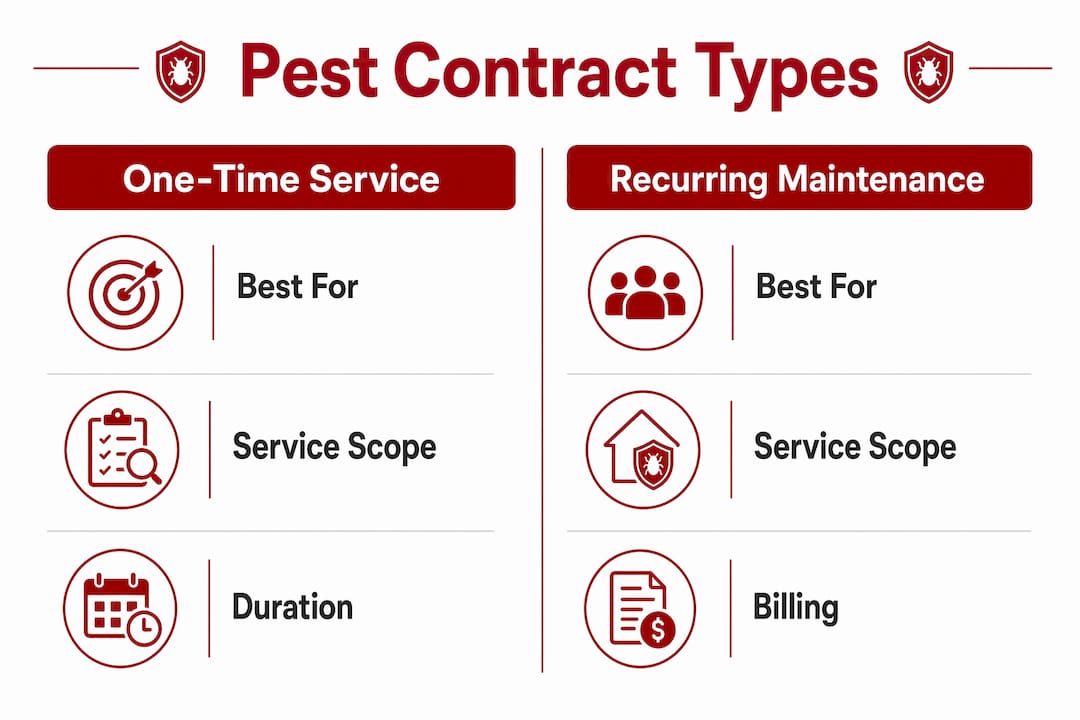
Contracts are either one-time services or recurring maintenance plans with scheduled visits monthly or quarterly. Each type suits a different situation, and choosing the wrong one costs money.
| Contract type | Best for | Service scope | Duration | Billing |
|---|---|---|---|---|
| One-time agreement | Specific infestation (e.g., bedbugs, wasps) | Single treatment with limited warranty | Days to weeks | Flat fee upfront |
| Recurring maintenance | Ongoing prevention for homes or multi-unit properties | Scheduled inspections and treatments | 6 to 24 months | Monthly or quarterly |
| Specialized (e.g., termite) | Wood-destroying organism control | Targeted treatment plus monitoring | Annual with renewal | Annual fee |
| Government or commercial | Large facilities, offices, public buildings | IPM-compliant, fully documented | Long-term | Contract tender |
One-time agreements work well when a homeowner spots a wasp nest or a single mouse entry point. The treatment happens, a short warranty covers retreatment if the problem returns within a defined window, and the agreement closes. Recurring maintenance contracts, by contrast, focus on prevention. Technicians visit on a set schedule to inspect, monitor, and treat before infestations take hold. This model suits property managers who cannot afford reactive exterminations across dozens of units.
Government pest control contracts demand certified applicators, insurance, IPM compliance, and detailed documentation for audits. These are far more formalized than residential agreements and serve as a useful benchmark for what a thorough contract looks like at any level.
Pro Tip: If you manage more than three rental units, a recurring maintenance contract almost always costs less per visit than repeated one-time call-outs. Ask providers to quote both options side by side before signing.
What should a pest management contract include?
A well-drafted pest control agreement covers every element that could become a dispute later. Here are the core components every contract should contain:
- Scope of services. The contract must name the specific pests covered, such as ants, cockroaches, rodents, or bedbugs, and list the treatment areas including interior rooms, exterior perimeter, loft spaces, and drains.
- Service schedule and duration. Exact visit dates or frequency windows (monthly, quarterly) and the total contract length must appear in writing.
- Pricing and payment terms. 77% of homeowners report surprise costs as a top frustration, which means detailed contracts that list total cost, accepted payment methods, and late fees are not a formality. They are a financial safeguard.
- Warranty and retreatment policy. The contract must state the exact retreatment window, the conditions that trigger it (such as pest recurrence within 30 days), and any site conditions that could void coverage.
- Client obligations. You are responsible for providing access on scheduled visit days, clearing treatment areas, and following any preparation instructions. Missing these obligations can void your warranty.
- Termination and renewal terms. Look for notice periods (typically 30 days), automatic renewal clauses, and any cancellation fees.
- Contractor licensing and insurance. The provider’s license number and public liability insurance details must appear on the document.
- Signatures. Both parties must sign and date the agreement before any treatment begins.
Integrated Pest Management contracts go further by documenting monitoring schedules and prevention methods alongside treatment records. This approach reduces pesticide applications over time, which matters for households with children or pets. Quickpestcontrol’s approach to pest management services follows IPM principles, meaning your contract reflects a plan built around long-term prevention, not just reactive spraying.
Pro Tip: Read every warranty clause twice. If the language says “guaranteed results” without specifying the retreatment window or conditions, that guarantee is unenforceable. Ask the provider to rewrite it with explicit timeframes before you sign.
How do regulations affect pest management contracts?
Regulation shapes what a pest control agreement must contain, especially for termite and wood-destroying organism treatments. Florida Rule 5E-14.105 mandates signed contracts prior to treatment for wood-destroying organisms and requires disclosure of pest species covered, maximum prices, and renewal fees. While this is a U.S. state example, it illustrates the level of specificity regulators expect and sets a useful standard for what any homeowner or property manager should demand in writing.
“Clear contract terms, especially for termite treatments, are crucial to reduce ambiguity and set customer expectations on pricing and renewal obligations.” — Insight drawn from Florida Rule 5E-14.105
In the UK, pest control operators must comply with the Control of Pesticides Regulations and the Health and Safety at Work Act. Pesticide applications must follow label instructions exactly, and applicators must hold recognized qualifications such as the British Pest Control Association (BPCA) certification or a City and Guilds award. A contract that does not reference the provider’s qualifications or compliance with these standards is a red flag.
| Regulatory requirement | What it means for your contract |
|---|---|
| Licensed applicator | Provider’s license or certification number must appear on the agreement |
| Pesticide label compliance | Methods used must match approved label instructions |
| IPM documentation | Contracts should record monitoring and prevention steps, not just treatments |
| Termite or WDO disclosure | Species covered, max price, and renewal fees must be stated explicitly |
For property managers, regulatory compliance also protects you from liability. If a tenant suffers harm from an improperly applied pesticide and your contract lacks documentation of the provider’s qualifications, you share the exposure. A compliant, well-documented pest control agreement is your first line of defense.
How to review, negotiate, and manage your pest control contract
Reading a pest control agreement carefully before signing takes about 20 minutes and can save you hundreds of dollars in disputes. Here is how to approach it:
- Check the scope line by line. Confirm that every pest you are concerned about is named. “General pest control” without a species list is vague and may exclude the exact problem you hired the company to solve.
- Verify the retreatment guarantee. Vague guarantee language may mislead; the exact retreatment window and conditions must be cited explicitly to be enforceable. If the contract says “we guarantee results” without a timeframe, push back.
- Negotiate pricing transparency. Ask for a breakdown of costs per visit versus setup fees. This makes it easier to compare quotes from multiple providers.
- Align service visits with your schedule. Property managers should coordinate visit dates with tenant availability. Tenant access and site preparation obligations are often overlooked but are crucial for recurring maintenance agreements. A missed appointment caused by a locked unit can void your warranty coverage.
- Track every visit. Keep a log of service dates, technician names, products used, and any follow-up actions required. This record supports warranty claims and helps you spot if visits are being skipped.
- Note renewal dates. Many contracts auto-renew with a price increase. Set a calendar reminder 60 days before the contract end date so you have time to renegotiate or switch providers.
Pro Tip: Ask for a service contract checklist before your first meeting with a provider. Reviewing a checklist in advance helps you ask the right questions and spot gaps in the proposed agreement.
Key takeaways
A pest management contract protects homeowners and property managers by documenting every service, responsibility, and warranty term in writing before treatment begins.
| Point | Details |
|---|---|
| Contract definition | A written agreement naming pests, treatment areas, schedule, pricing, and warranty terms. |
| Contract types | One-time agreements suit specific infestations; recurring plans suit ongoing prevention. |
| Regulatory compliance | Contracts must reference provider licensing and pesticide compliance to be legally sound. |
| Warranty clarity | Retreatment windows and conditions must be explicit, not implied, to be enforceable. |
| Client obligations | Access and site preparation duties belong in the contract to protect your warranty coverage. |
Why I think most people sign pest contracts without reading them
From my experience working alongside pest control professionals and property managers across London, the single biggest mistake is treating the contract as a formality. People see a pest problem, they want it gone, and they sign whatever is put in front of them. That urgency is understandable. Rodents slipping through gaps in a kitchen wall or bedbugs spreading from one flat to the next create real stress. But signing without reading is how you end up with a “guarantee” that covers retreatment only if you give 48 hours’ notice, keep the property at a specific temperature, and call within 14 days. None of that is unreasonable on the provider’s side. The problem is you never knew those conditions existed.
The other thing I see consistently is property managers underestimating how much tenant cooperation affects contract outcomes. A recurring maintenance plan is only as good as the access it gets. If tenants are not informed about visit schedules, treatments get skipped, pests return, and the warranty claim gets denied because the provider could not complete the service. That is not a pest control failure. It is a contract management failure.
My honest recommendation is to treat a pest management contract the way you would treat a lease agreement. Read it, ask questions, and negotiate anything that feels vague. A reputable provider will not object to clarifying their terms. If they do, that tells you something important before you have spent a penny.
— Azmat
How Quickpestcontrol can help with your pest management needs

Quickpestcontrol offers tailored pest control services for homeowners and property managers across London, with clear written agreements that spell out every service, schedule, and warranty term before work begins. Whether you need a one-time treatment for a cockroach infestation or a recurring maintenance plan covering multiple rental units, Quickpestcontrol’s qualified technicians deliver solutions built on Integrated Pest Management principles. For property managers, the commercial pest management options include documented service records and compliance-ready contracts. Call today and receive a callback within one hour for urgent situations. Reliable, licensed, and transparent from the first signature.
FAQ
What is a pest management contract?
A pest management contract is a written service agreement between a licensed pest control company and a property owner that defines which pests will be treated, the treatment areas, service frequency, pricing, and warranty conditions.
Is a pest management contract necessary for homeowners?
A written contract is the only way to confirm what services you are paying for and what happens if the treatment fails. Without one, you have no legal basis to request a retreatment or dispute a charge.
What pest control contract terms should I watch out for?
Watch for vague warranty language that lacks a specific retreatment window, automatic renewal clauses with price increases, and scope descriptions that say “general pest control” without naming specific pests.
How does pest management work under a recurring contract?
Under a recurring pest control agreement, a licensed technician visits on a set schedule (monthly or quarterly) to inspect, monitor, and treat for pests before infestations develop, following IPM principles to reduce pesticide use over time.
What are the benefits of pest management contracts for property managers?
Recurring contracts give property managers documented service records, predictable costs, and warranty coverage across multiple units, reducing the risk of tenant complaints and liability from untreated infestations.